

A designer’s fee is not an extravagant luxury; it is a calculated investment that shields your overall project from costly construction mistakes. If you are evaluating the cost of interior designer Canada rates for an upcoming home renovation, basement suite, or commercial space, the broad spectrum of billing models can quickly feel unpredictable. It’s completely natural to worry about hidden product markups, prolonged trade delays, or confusing invoices that leave your bottom line vulnerable.
You deserve genuine financial clarity and thoughtful guidance before committing your hard-earned capital. In this guide, you’ll discover how Canadian design professionals structure their fees, what key factors drive your overall project investment, and how early professional planning safeguards both your timeline and vision. We break down common Canadian fee models, clarify the vital differences between decorating and technical interior design, and provide actionable budgeting strategies so you can shape an elegant, functional environment with complete confidence.
Key Takeaways
- Understand standard Canadian billing frameworks, from milestone fixed fees to hourly consulting, to accurately assess the cost of interior designer Canada services for your project.
- Identify how spatial complexity, square footage, and specialized documentation for kitchens, bathrooms, or commercial spaces drive design hours.
- Learn how separating conceptual planning fees from Furniture, Fixture & Equipment (FF&E) procurement eliminates hidden costs and maximizes trade value.
- Protect your renovation or new build from costly surprises by securing detailed drawings and setting aside realistic contingency reserves before construction starts.
- Discover the enduring value of professional planning that blends functional space optimization with sustainable, refined craftsmanship.
Understanding Interior Designer Fee Structures Across Canada
Securing genuine financial clarity begins with understanding how studios bill for their expertise. Across different provinces, the cost of interior designer Canada practices charge is rarely uniform, shifting between milestone commitments and time-based consulting to protect project momentum and creative vision.
Hourly Rates Versus Flat Project Fees
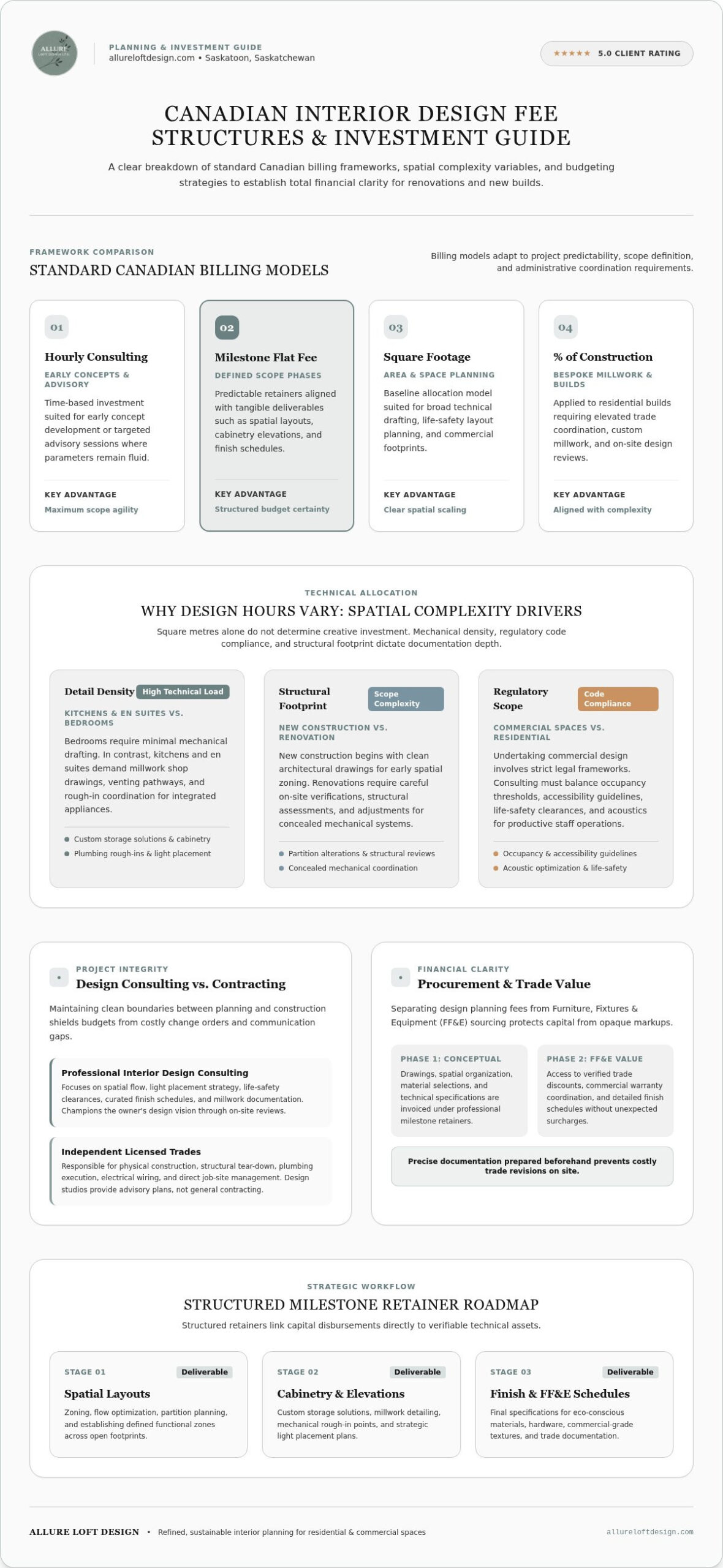
Hourly billing often suits early concept development or targeted advisory sessions where your project parameters remain fluid. In contrast, fixed-fee agreements offer predictable budgeting when you have established a defined scope. Many studios structure these commitments around milestone retainers, aligning payments with tangible deliverables such as spatial layouts, cabinetry elevations, and finish schedules. This approach ensures your investment matches completed design phases, establishing steady accountability from the start.
Percentage of Construction and Square Footage Models
For extensive commercial design projects, square footage models provide an intuitive baseline for technical drafting and space allocation. Custom residential builds with complex millwork might instead apply a percentage-of-construction model, directly reflecting the elevated coordination required for bespoke craftsmanship. High-end firms such as Rachel Horn Studio exemplify how comprehensive planning and tailored architectural detailing are essential on complex residential and resort properties. When evaluating the total cost of interior designer Canada proposals, always verify what falls within that percentage. Specifications, finish selections, and site design reviews should be explicitly defined rather than left ambiguous.
Consulting Agreements Versus Contracting Roles
A frequent misunderstanding in modern builds is blurring the boundary between design consulting and physical construction. The recognized interior design profession centres on spatial flow, lighting strategy, life-safety codes, and curated finishes. Design studios provide expert planning, drafting, and aesthetic guidance rather than general contracting services. Independent licensed trades handle structural execution, while your designer champions your vision on site. Establishing these distinct roles early safeguards project communication and protects your construction budget from avoidable revisions.
Primary Factors Influencing the Cost of Professional Design Services
Every floor plan presents distinct operational demands, meaning design investment is rarely determined by square footage alone. Regional market conditions, regulatory requirements, and technical depth all influence studio commitments. For example, baseline compensation rates highlighted in Government of Canada Job Bank wage data show that regional talent dynamics directly shape design rates. Understanding these underlying variables helps you anticipate where and why creative hours accumulate.
Scope Complexity: New Builds Versus Renovations
Working within an existing footprint invariably introduces structural surprises. Renovation scopes demand careful on-site verifications, structural assessments, and adjustments for concealed mechanical systems. In contrast, reviewing our guide on interior design for new construction shows how starting with clean architectural plans streamlines early spatial zoning. Whenever a project involves moving load-bearing partitions, re-routing plumbing, or resizing exterior openings, the design documentation required to coordinate trades naturally expands.
High-Detail Zones: Kitchens, Bathrooms, and Custom Cabinetry
Square metres are not created equal. A bedroom layout requires minimal mechanical coordination, whereas kitchens and primary en suites demand exhaustive technical focus. Designers must generate millwork shop drawings, align venting pathways, and coordinate rough-ins for integrated appliances. Investing in custom storage solutions elevates your daily living experience and spatial efficiency, yet it requires precise detailing to ensure flawless execution on site.
Commercial Space Requirements and Code Compliance
Undertaking a commercial space introduces rigorous legal frameworks that residential properties rarely face. Qualified commercial design consulting must balance occupancy thresholds, accessibility guidelines, life-safety clearances, and acoustic performance to optimize staff productivity. Reviewing our commercial space planning Saskatoon overview illustrates how zoning and traffic flow govern every layout choice. When estimating the total cost of interior designer Canada services for retail or corporate environments, allocating resources to early regulatory compliance prevents costly construction delays down the road.
Design Consulting Versus Purchasing: Sourcing, FF&E, and Trade Value
Design consulting establishes the conceptual roadmap, while procurement brings tangible elements into reality. A clear assessment of the cost of interior designer Canada proposals hinges on recognizing where creative planning stops and purchasing logistics begin. Sourcing Furniture, Fixtures, and Equipment (FF&E) is a specialized service designed to safeguard material quality and spare clients from retail supply chain headaches.
Understanding FF&E Procurement Models
Designers don’t simply curate retail items; they source through trade-only manufacturers, architectural hardware suppliers, and bespoke textile mills. As outlined in professional standards championed by the Interior Designers of Canada (IDC), procurement agreements typically follow a cost-plus arrangement or a shared trade-discount structure. The associated coordination fee funds purchase management, freight tracking, customs documentation, warehouse inspection, and damage claims. This shields your investment from defective deliveries and endless administrative follow-ups.
The Impact of Curated Lighting and Material Selection
Deliberate material choices fundamentally govern daily well-being and spatial longevity. Strategic light placement enhances visual comfort, highlighting focal points and balancing natural daylight through thoughtful layering. Pairing tailored illumination with natural and warm materials, such as rift-sawn oak and tactile linens, grounds a room in organic calm. Coordinating these elements with durable flooring upgrades balances acoustic performance and wear resistance, maintaining aesthetic refinement in high-traffic settings.
Long-Term Return on Quality Furnishings
High-grade construction and commercial textiles deliver tangible financial returns by resisting premature wear. For urban homes or condominiums, incorporating multifunctional furniture into compact layouts unlocks flexible utility without sacrificing open circulation. Investing in timeless craftsmanship minimizes disposable replacement cycles and reduces unnecessary waste. When measuring the overall cost of interior designer Canada collaborations, the lifetime durability gained through curated trade sourcing balances upfront investment with enduring peace of mind.
How to Budget for Interior Design and Prevent Cost Overruns
Uncontrolled project expenditures rarely stem from design fees; they happen when construction begins without finalized documentation. Canadian building benchmarks recommend setting aside a 15% to 20% contingency reserve for renovations, and 10% for new builds, to absorb structural discoveries. Learning when to hire an interior designer ensures your drawings are complete before soliciting trade quotes, eliminating costly mid-build alterations.
Phase Your Project for Predictable Cash Flow
Segmenting your project into structured milestones establishes manageable financial intervals. Phase one centres on spatial evaluation, conceptual layouts, and functional zoning. Phase two generates exact millwork elevations, electrical schedules, and finish specifications. Phase three oversees final procurement and white-glove installation coordination. This phased cadence provides clear budget oversight, ensuring you don’t commit capital to detailed sourcing until spatial plans are approved.
Preventing Construction Delays Through Complete Documentation
Detailed design packages serve as a shield against site delays. When trades receive unambiguous drawings, they quote on actual conditions rather than inflated allowances. Early smart home integration planning maps technical conduits, motorized shading pockets, and device wiring before drywall installation proceeds. Investing early in professional planning lowers the realized cost of interior designer Canada services by preventing change orders, scheduling conflicts, and expensive trade downtime.
Setting Priorities: Where to Invest and Where to Save
Thoughtful capital allocation focuses on daily touchpoints and foundational architecture. Direct your resources toward high-traffic surfaces, bespoke kitchen cabinetry, and statement architectural illumination. You can create comfortable, defined zones using textured area rugs and layered light placement rather than constructing expensive permanent partition walls. Balancing bespoke architectural millwork with flexible loose furniture optimizes total project outlay while maintaining a refined aesthetic.
Ready to protect your construction budget and bring clarity to your vision? Connect with our design team to establish an intentional plan tailored to your lifestyle and space.
Investing in Design Consultation with Allure LOFT Design
Every home or workspace holds unique potential that deserves a tailored, mindful approach. Backed by a 5 out of 5 customer rating and founded circa 2018 by Principal Designer Amanda Loftsgard, Allure LOFT Design provides full-service residential and commercial interior design consulting in Saskatoon. Our studio blends functional space planning with quiet, understated luxury, ensuring that evaluating the cost of interior designer Canada services leads directly to peace of mind, operational harmony, and lasting beauty.
A Thoughtful, Human-Centric Design Process
Our collaborative journey begins by understanding your lifestyle rhythms, acoustic requirements, and functional preferences. We believe that true sophistication balances modern innovation with calming, sustainable environments. Every design decision, whether selecting eco-conscious materials or applying feng shui design principles to support positive energy flow, serves an intentional purpose. Rather than pursuing fleeting trends, our studio crafts timeless spaces that foster restorative comfort and elevate daily living.
Custom Cabinetry and Curated Sourcing Expertise
Specialized joinery forms the structural backbone of exceptional interior architecture. With deep expertise in kitchen, bath, and custom home cabinetry, we detail every elevation to match your daily habits. Beyond millwork, our team manages curated FF&E procurement, connecting your project with trusted trade suppliers for designer lighting, household products, furniture, and unique architectural accessories that cannot be sourced from mass retail showrooms.
Next Steps: Initiating Your Design Journey
Beginning a design collaboration should feel orderly and reassuring from your first inquiry. Here is how our consulting partnership takes shape:
- Discovery Consultation: We meet to evaluate your property’s footprint, review inspiration, and discuss your lifestyle or commercial objectives.
- Tailored Scope Proposal: You receive a transparent roadmap outlining deliverables, milestone reviews, and technical documentation timelines.
- Design Development: Our studio drafts detailed space plans, curates finishes, and refines millwork elevations ready for trade bidding.
A well-planned space transforms how you rest, gather, and work. When weighing the overall cost of interior designer Canada investments, choosing a dedicated design partner ensures your vision unfolds with deliberate care, structural integrity, and exceptional refinement.
Elevate Your Environment with Intentional Design Planning
Navigating the true cost of interior designer Canada professionals charge comes down to recognizing long-term value over upfront expense. Phasing your project, completing detailed millwork specifications before trades submit bids, and relying on transparent procurement protect your capital from unforeseen site revisions. Early planning turns potential renovation stress into an orderly, inspiring process, ensuring your finished space fosters daily comfort and effortless productivity.
Founded circa 2018 under Principal Designer Amanda Loftsgard, Allure LOFT Design holds a 5 out of 5 client satisfaction rating for delivering thoughtful, sustainable interiors across Saskatchewan. With specialized expertise in custom cabinetry, architectural lighting, and curated FF&E procurement, our studio ensures every material balances functional utility with understated beauty. Connect with Allure LOFT Design to schedule your design consultation and begin crafting a refined environment tailored to your lifestyle.
Frequently Asked Questions
How much does an interior designer typically charge in Canada?
Fee structures vary depending on project scale, spatial complexity, and location across the provinces. Rather than a single fixed rate, the overall cost of interior designer Canada practices charge is typically billed through hourly advisory rates, milestone-based fixed fees, or a percentage of total construction and finish costs. Commercial developments and custom residential builds often combine fixed fees for early schematic planning with percentage models for ongoing site administration.
What is the difference between an interior designer and an interior decorator?
In Saskatchewan, “Interior Designer” is a legally protected title governed by provincial legislation. Registered interior designers possess specialized degrees, pass NCIDQ examinations, and evaluate building codes, accessibility standards, and spatial partitions. Interior decorators focus primarily on surface aesthetics, such as colour palettes, loose furnishings, and window coverings. Choosing an accredited designer ensures your space complies with technical building requirements alongside visual refinement.
Are interior design consulting fees tax-deductible for Canadian businesses?
Professional design consulting fees for Canadian commercial spaces are generally deductible through the Canada Revenue Agency. Design work tied directly to ongoing operations is often claimed as a current business expense, while costs related to substantial renovations or structural leasehold improvements are capitalized and depreciated under the Capital Cost Allowance (CCA). In Saskatchewan, remember that design services and material purchases carry an 11% combined sales tax (6% PST and 5% GST).
How do designers charge for Furniture, Fixtures, and Equipment (FF&E)?
Studios typically manage FF&E procurement under a cost-plus structure or a shared trade-discount framework. Designers source directly from trade-only suppliers, passing along negotiated wholesale pricing alongside an agreed purchasing coordination fee. This fee compensates the design team for writing purchase orders, tracking freight logistics, overseeing storage, and conducting damage inspections prior to final installation, protecting you from retail markups and delivery headaches.
Can hiring an interior designer actually save money on a renovation?
Professional planning directly prevents expensive construction mistakes. When contractors bid on exhaustive drawing sets with finalized finish specifications, they don’t add broad allowances or encounter mid-build surprises. Complete documentation eliminates costly demolition rework, prevents plumbing misalignments, and minimizes scheduling delays. Investing in the cost of interior designer Canada services early ultimately safeguards your budget by streamlining trade execution from demolition to final walk-through.
When during a build or renovation should I bring in an interior designer?
You should involve an interior design consultant during the conceptual planning phase, well before hiring contractors or finalizing architectural blueprints. Engaging a designer early ensures electrical rough-ins, plumbing drops, and partition walls align perfectly with your proposed furniture layouts and custom cabinetry. Early collaboration between your designer, architect, and builder prevents expensive structural revisions once framing begins on site.
Do interior designers provide general contracting services during construction?
Interior design studios deliver design consulting, spatial planning, material specifications, and aesthetic site reviews, but they do not provide general contracting services. Design professionals act as your creative and technical advocate, ensuring the construction aligns with the approved documentation. Physical demolition, framing, plumbing, and trade supervision remain the distinct responsibility of independent, qualified general contractors and licensed subtrades.