

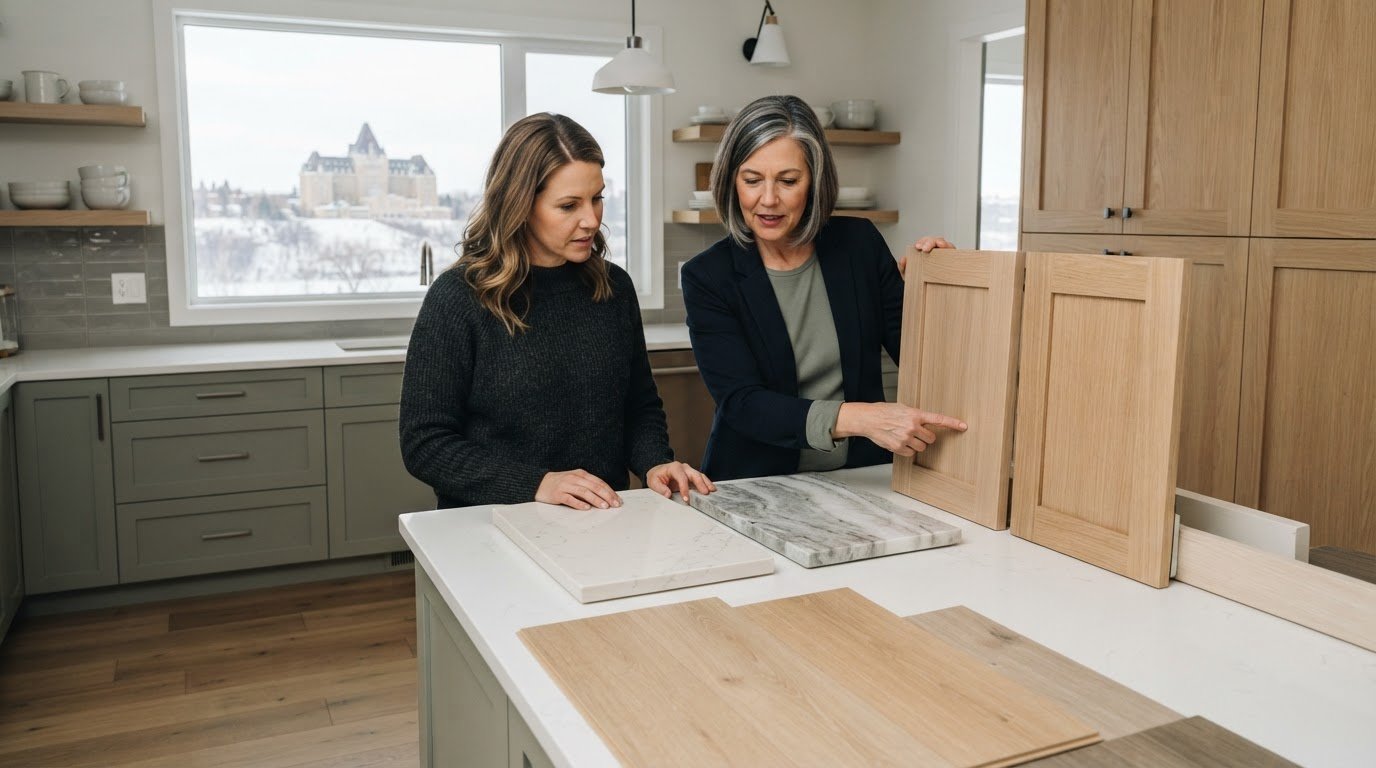
Finish choices shape both the feel of a new home and its final price. In Saskatoon, material selection for a new home can include cabinets, countertops, flooring, fixtures and paint colours, with each choice contributing to the overall cost. Understand which finishes are included and which are upgrades before finalizing decisions.
Colour and style matter, but materials should also suit everyday routines, comfort and long-term use. A practical surface in a busy kitchen, thoughtful lighting and coordinated finishes can make a home feel considered without compromising function.
This guide explains how finish options differ, what can affect their cost and how to weigh appearance, durability and sustainability. You’ll find a practical comparison of common material choices and a decision guide to help prioritize what matters in your Saskatoon home.
Key Takeaways
- Separate standard finishes from paid upgrades so you can prioritize the details that matter most to your household.
- Consider how cabinets, countertops, flooring, fixtures and paint colours work together, as individual choices contribute to the home’s overall price.
- Compare materials for durability in Saskatoon’s cold climate and freeze-thaw conditions, not appearance alone.
- Assess windows, doors and air-sealing options as part of a home’s overall comfort and energy performance.
- Factor supplier availability into material decisions, and keep suitable alternatives in mind when selecting finishes.
Customizable home finishes and upgrades
New Saskatoon homes can be tailored with choices such as cabinets, countertops, flooring, fixtures and wall colours. First separate included finishes from upgrades, then assess each option against your household’s routines and design priorities.
Finish and Fixture Choices
Cabinet finishes, countertops, flooring, fixtures and paint colours shape a home’s appearance and everyday function. Cabinetry and counters define kitchens and bathrooms, while flooring and paint help create continuity between living spaces. Ask for the finish specifications and upgrade options before choosing, since each selection affects the final price.
Sustainable and Low-Maintenance Materials
In Saskatoon, discuss eco-conscious and low-maintenance options for flooring, cabinets, countertops and fixtures within the builder’s finish selections. Compare each by care needs, durability and how well it suits your household; the available choices depend on the materials offered for the home. A finish that is easy to maintain may suit a busy entry, while a considered cabinet selection can support a cohesive kitchen design.
| Option | Customization | Decision focus |
|---|---|---|
| Cabinets and countertops | Finish and surface choices | Room function and coordination |
| Flooring | Material and colour | Care needs and continuity |
| Fixtures and paint | Style and colour | Comfort and visual harmony |
Start with how each material will be used, then compare its appearance and maintenance requirements.
Home design decisions can also begin with the floor plan. Buyers may select a standard builder-provided plan or a fully custom design, then consider how room arrangement supports their routines. A kitchen connected to shared living areas, for example, can make everyday movement and family gatherings feel more natural. Ask about the feasibility of desired modifications so the design remains functional and structurally sound.
Warranty coverage and customer care matter after selections are made. Most new homes in Saskatchewan are backed by the Saskatchewan New Home Warranty Program, with one year of materials and finishes coverage, two years of building-envelope coverage, and ten years of structural coverage. Some builders allow walkthroughs at set construction stages. At the final walkthrough, inspect the home with the builder and note any discrepancies or imperfections before possession.
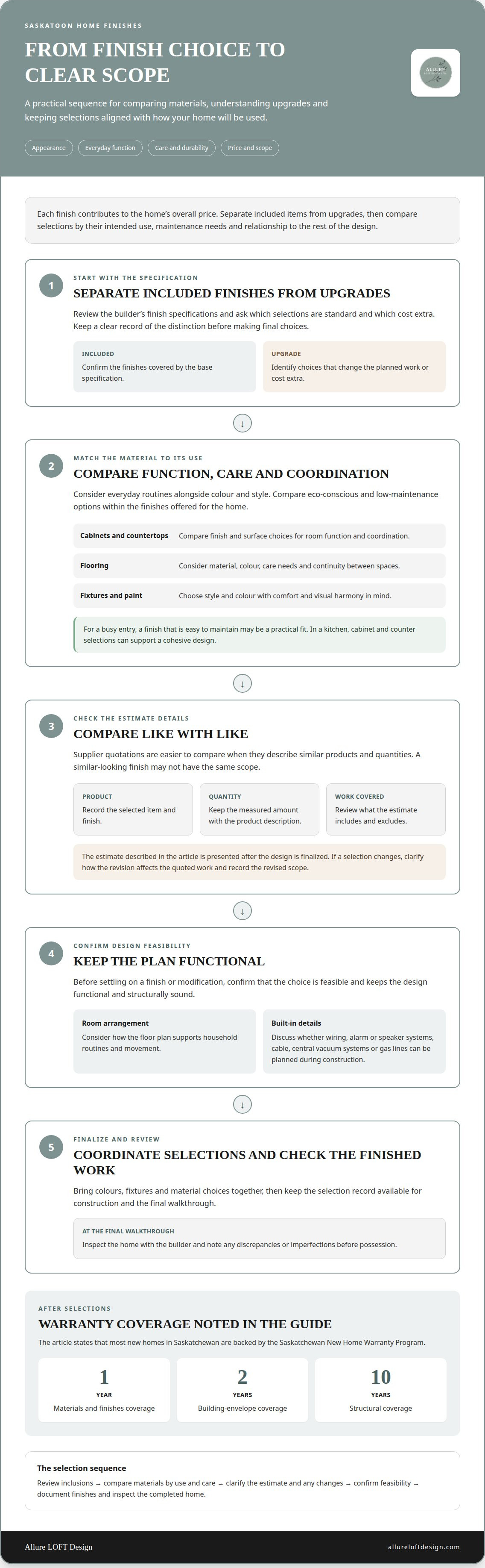
Keep decisions organized: review included finishes, identify upgrades, compare materials by function, then finalize colours and fixtures. This sequence helps align the home’s appearance with its use and keeps each selection visible in the overall design.
Maintain a clear record of selected finishes, noting which items are standard and which cost extra after asking the builder to clarify the distinction. Choose cabinets, countertops, appliances, flooring, fixtures and wall paint colours with your actual lifestyle and needs in mind, rather than treating appearance as the only consideration. Before settling on a design, ask the builder whether your choices and possible modifications are feasible and will keep the design functional and structurally sound.
Warranty and customer care are important considerations when choosing a builder. You can also discuss whether technology can be built in or installed during construction, including alarm and speaker systems, internet wiring, cable, security alarms, central vacuum systems and gas lines. Considering these alongside finish selections helps you plan the details of your new home.
How finishing materials affect the final price
A new-home estimate is most useful when it reflects a clearly defined scope. Review how each material is described, measured and included, then distinguish the base specification from any change to the planned work.
Wood Building Materials
Wood may be used in structural components, cabinets, flooring and trim, so its cost relates to different parts of a project. Compare the stated product, finish, quantity and intended use rather than treating “wood” as a single budget category. In Saskatoon, consider where each product will be used and how it fits the planned construction.
Local Supplier Availability
Supplier quotations are easiest to compare when they describe similar products and quantities. A quote for one cabinet finish may not be comparable to another if the specifications differ. Keep the product description, finish and measured amount together when reviewing selections. This gives you a clearer basis for comparing costs without assuming similar-looking materials have the same scope.
Material Selection Risks
A key risk is approving a design choice without understanding whether it changes the original work. A different surface may affect the specified quantity or require a scope revision. Unforeseen circumstances and changes in preference can also lead to additions during construction. Discuss the quoted cost and potential variance before approving a change, and record the revised scope.
In the Saskatoon home-building process described, the builder presents an estimate after the design is finalized. The estimate therefore reflects the decisions made for that design. Review its inclusions and exclusions before treating it as the project’s full cost. If a selection changes later, clarify how the revision affects the quoted work.
Ask how each material is accounted for in the estimate. A specification should identify the selected item and the work it covers, while a change should state what is being added or replaced. For example, changing a planned finish calls for a clear explanation of how the new choice affects the scope. This keeps the discussion focused on the decision and its cost.
Construction payments may be arranged as milestone-based instalments or as a one-time lump sum. Understand which arrangement applies to the project and how approved changes relate to payment discussions. Keep a record of the agreed scope and revisions so you and the builder can refer to the same decisions as construction progresses.
For a new home in Saskatoon, material selection is easier to manage when every choice has a defined specification, scope and place in the estimate. Review those details before approving changes.
What building materials are best suited to Saskatoon’s cold climate and freeze-thaw cycles?
No single material is right for every part of a Saskatoon home. Choose each finish for its location, intended use, exposure and maintenance needs, then consider how it works with the rest of the design.
Freeze-thaw cycles make exterior performance an important consideration in material selection. Exterior finishes shape a home’s appearance and must suit exposure to the elements. Compare options by their intended application and care requirements. An exposed exterior finish, for example, calls for different considerations than flooring in a frequently used entry.
Look beyond colour samples and assess each proposed finish in context. Consider how exterior colours work with the home’s overall design and how interior surfaces suit the rooms where they’ll be used. Ask which options are available for each application and what maintenance they require. These criteria make trade-offs clearer without assuming one material suits every home.
Material decisions should fit the home’s design and construction scope. If a preferred finish involves a modification, discuss how it fits the plan. A change to an exterior detail, for instance, should be considered alongside the surrounding design. This keeps function and structural considerations in view alongside appearance.
- Exterior finishes: Compare appearance, intended application, exposure and maintenance.
- Interior finishes: Match the finish to the room’s use and household routines.
- Design modifications: Consider feasibility and how changes fit the overall plan.
In Saskatoon, material suitability also depends on how each choice fits the home’s broader design. New homes may include modern heating systems and higher levels of insulation. Consider selected materials alongside these features, without treating a finish as a substitute for the home’s overall design or construction approach.
For a practical review, organize selections by location: exterior walls, entry areas, kitchens and living spaces. Compare each option by function, visual effect and upkeep. Flooring in a busy entry, for example, should suit the room’s everyday use. This keeps decisions grounded in the needs of each space.
Discuss proposed choices and modifications with the builder to assess their fit with the design. A clear conversation about where a material will be used and what care it requires helps guide selection. For Saskatoon’s climate, focus on the intended application and complete design rather than assuming one material is universally best.
For lower-maintenance choices, compare available finishes by application, exposure and care requirements. Select materials for each location and use rather than assuming one option suits the whole home.
What energy-efficient window, door, and air-sealing materials are recommended for Saskatoon homes?
No single window, door or sealing material suits every Saskatoon home. Base selections on the home’s design, the location of each opening and the product information for the specific build.
For windows, compare the options presented for the home by their stated features, appearance, maintenance needs and fit with the design. Consider how each window relates to its room, intended use and surrounding finishes. A living-room window, for example, should suit the layout and the way light and views shape the interior.
Use the same approach for exterior doors. Consider the entry’s role, the home’s architectural style and how the door coordinates with nearby windows and exterior finishes. Review product details as a complete selection rather than inferring them from a material name or appearance. This keeps decisions grounded in information about the proposed option.
Air sealing is another element to discuss as part of the home’s design. Ask how the planned approach relates to windows, doors and other openings, and how it fits the surrounding construction. Consider the specific design rather than assuming one product or method suits every junction. Where openings meet different finishes, think about how the details will look together.
- Windows: Compare stated product details, room use, appearance and maintenance.
- Exterior doors: Consider the entry’s function and relationship to the home’s design.
- Air sealing: Discuss how the planned approach applies around openings and adjoining construction.
For an energy-conscious selection, review the information for each proposed option alongside the home’s overall plans. Modern heating systems and higher levels of insulation may be part of new-home design, so consider windows and doors in that wider context. Avoid judging performance by appearance alone; use the details supplied for the actual selection.
A practical review can follow the home’s drawings. Identify each window and exterior door, note its location and compare the proposed options. Then consider how related details fit the design and surrounding finishes. This helps distinguish the needs of a front entry, a patio door and a bedroom window without assuming they are identical.
For Saskatoon homeowners, the most useful recommendation is a coordinated choice based on the proposed products, their stated information and the home’s design. Discuss how windows, doors and air sealing fit together for the specific build, then weigh comfort, appearance and maintenance before finalizing selections.
Choose windows, doors and air-sealing approaches based on the proposed products, their stated details and how they fit the home’s design and openings. No single material is right for every Saskatoon home.
How do local Saskatoon suppliers and availability affect new-home material choices and costs?
In Saskatoon, material availability can shape which finishes enter a new-home plan and when selections need to be finalized. Prices can fluctuate, so consider supplier timing and product choice in cost discussions before construction moves forward.
Availability affects both the specific product and the range of alternatives. A selected tile, cabinet finish or fixture may be available through local supply channels, while another choice may need to be ordered. If a preferred item does not fit the project schedule, a substitute may affect colour coordination, dimensions or the estimate. Treat alternatives as design decisions, not last-minute replacements.
Create a material schedule that records each selection by room, product description, finish and quantity. For example, list the kitchen cabinet finish separately from bathroom cabinetry, even if the colours look similar. This gives selections a clear reference point during pricing and ordering, and helps identify where a product change could affect nearby finishes.
Supplier availability can affect construction sequencing. A finish needed early in the build may require a decision before decorative items chosen closer to possession. Align material choices with the stage when each item is needed. If a preferred surface or fixture is unavailable, compare alternatives by dimensions, function, appearance and compatibility with the design.
- Record selections: Note the room, finish and product description for each choice.
- Compare substitutes: Consider fit, appearance and function, not colour alone.
- Track revisions: Keep approved changes connected to the current estimate and scope.
Before approving a substitute, consider its effect on the whole room. A different countertop, for instance, may change how the cabinetry, backsplash and hardware work together. A replacement fixture may also differ in size or finish. Reviewing these relationships helps preserve a cohesive design while accounting for product supply.
Discuss quoted costs, potential price variances and factors that could affect the final bill as selections evolve. Material prices can change, and unforeseen circumstances or preference changes may add to the original scope. Written records of approved choices and revisions help keep discussions clear between the homeowner and builder.
For Saskatoon buyers, the practical approach is to make key decisions early, document exact selections and keep suitable alternatives in view. This makes availability part of the design process, rather than a surprise after choices have been made. Allure LOFT Design’s Renovation & New Build Consulting can help bring material decisions into a coordinated plan for the home.
and approved alternatives in writing, so each change can be checked against the room plan and estimate. Budgeting should also account for costs beyond the mortgage, including the deposit, legal fees, title transfer, property taxes, home insurance, utility hook-ups, mailbox keys, and blinds. In Saskatchewan, new-home build times can vary with the home model, construction stage, season, permitting, and material availability. A quick-possession home is already under construction or completed and available for a faster move-in timeline. Buyers weighing that option can distinguish an available home from a build whose timing may shift with supply and other conditions.
Allure LOFT Design: Kitchen, Bath and Home cabinets
Allure LOFT Design offers Kitchen, Bath and Home cabinets for homeowners creating a cohesive new-home interior. This service can help when cabinet choices need to support both practical storage and the character of a kitchen or bathroom. Consider finish, colour and layout alongside nearby surfaces and fixtures, since these decisions shape how the rooms look and function.
Thoughtful cabinet selection can bring visual harmony to everyday spaces, from a streamlined kitchen to a calm, well-organized bathroom. Allure LOFT Design can connect these choices to your design priorities and the way you plan to use each room.
Contact Allure LOFT Design to discuss cabinet choices for your new Saskatoon home.
Shape a home that feels considered from the start
Material selection for a new home in Saskatoon is an opportunity to create spaces that reflect your priorities, not just follow a finish schedule. Consider how each decision supports the way you live and fits within the wider plan. Bring your preferences, practical needs and ideas together before selections are finalized.
Allure LOFT Design offers Renovation & New Build Consulting to help shape project decisions, along with Furniture, Fixture & Equipment (FF&E) Procurement for considered furnishings and fixtures. Its Commercial Interior Design serves business environments, where materials also contribute to comfort and productivity.
Whether you’re refining a new-home vision or planning a commercial space, contact Allure LOFT Design to discuss your design priorities. Your next decisions can bring lasting function and a sense of harmony to the spaces you create.