

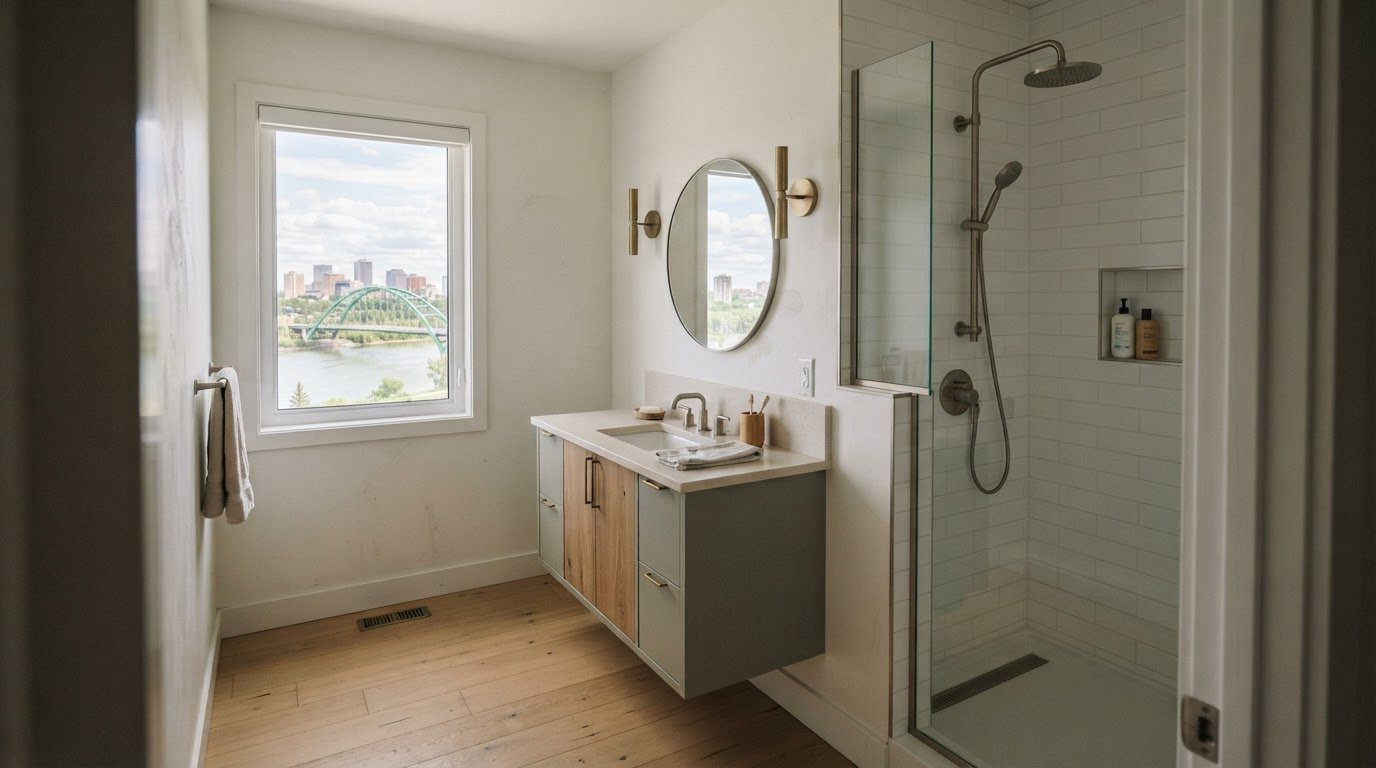
Yes, you can mix bathroom metals and still create a calm, cohesive room. Let one finish lead and use a contrasting metal as a deliberate accent. This guide to selecting bathroom fixtures shows how to bring that balance into a minimalist design.
The hesitation is understandable: faucets, shower fittings, handles and lighting are all in view, so unrelated finishes can make a carefully planned space feel unsettled. A considered mix, however, adds depth without requiring every fixture to match.
Learn how to coordinate metals, choose a bath or shower for the room’s footprint, and weigh sink materials and installation styles against daily use. You’ll also see how to pair a sculptural or richly finished fixture with clean lines, practical storage and comfortable lighting, whether you’re renovating a Saskatoon condo or planning a home build. The goal is a bathroom that feels distinctive yet composed, with choices that support function and lasting visual harmony.
Key Takeaways
- Choose a dominant metal finish, then use contrasting finishes as intentional accents to keep the room cohesive.
- Let the bathroom’s footprint and daily routines guide whether a bath, shower or combined option makes the best use of space.
- Compare sink materials and installation styles by balancing visual impact with the needs of the people using the bathroom.
- Give minimalist design character with a bold fixture, while keeping surrounding details restrained and functional.
- Consider water-conscious fixtures as part of a bathroom plan that balances comfort, durability and sustainability.
1. How can I ensure consistency when mixing finishes in the bathroom?
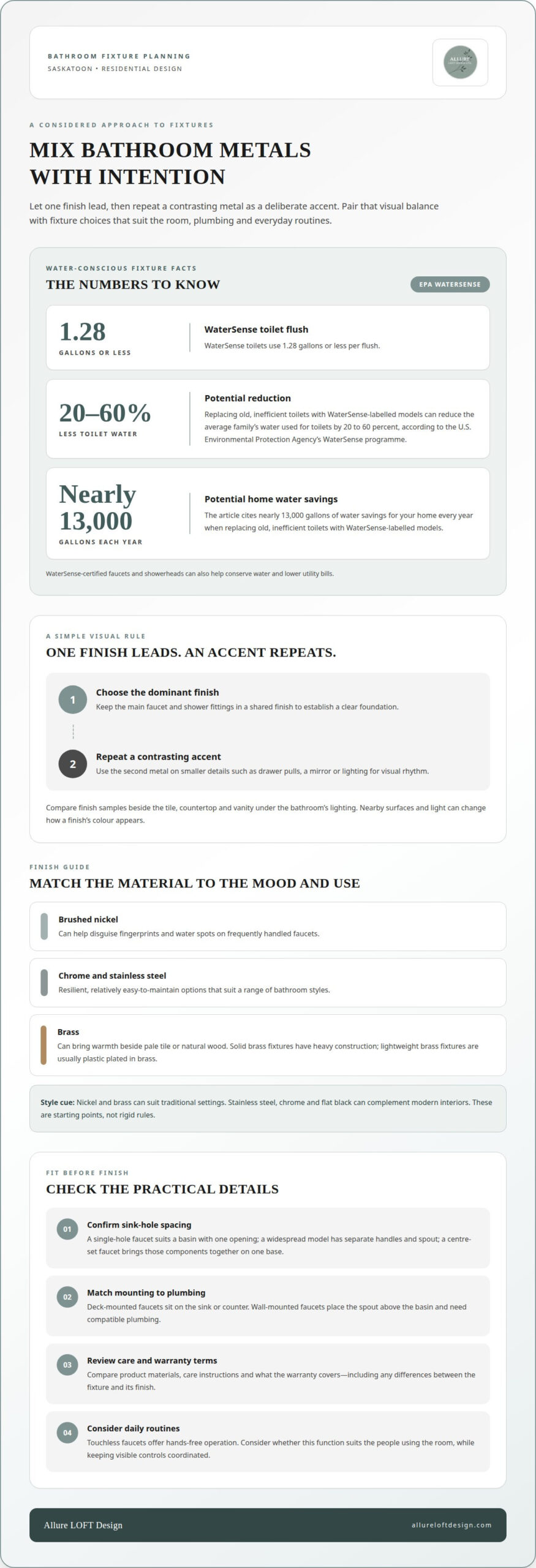
Build a coordinated palette before choosing faucets, shower fittings and cabinet hardware. Start with one dominant finish, then introduce a second as a deliberate accent. For example, chrome faucets can anchor a bright, streamlined scheme, while darker shower controls add contrast. Repeat the accent in one or two smaller details. This creates visual rhythm without requiring every surface to match.
Materials influence both appearance and everyday care. Brushed nickel can help disguise fingerprints and water spots, making it a practical choice for frequently handled faucets. Chrome and stainless steel are resilient, relatively easy-to-maintain options that suit a range of bathroom styles. Brass can bring warmth beside pale tile or natural wood. Compare finishes on the faucet, showerhead and handles, since lighting and nearby surfaces can change how a colour appears.
Before choosing a faucet, identify the sink configuration and existing hole spacing. A single-hole faucet suits a basin designed for one opening; a widespread model uses separate handles and a spout. A centre-set faucet brings those components together on one base. The sink’s layout determines which configuration will fit. Match the faucet to the available openings rather than choosing a style first and assuming it will work.
Mounting affects the room’s proportions and practical requirements. Deck-mounted faucets sit on the sink or counter, while wall-mounted faucets place the spout above the basin. Wall-mounted designs need compatible plumbing, so include them in renovation planning. Check that replacement faucets and showerheads suit the existing plumbing. Doing so can help avoid modifications and keep the finish plan aligned with the installation.
Water efficiency belongs in the same decision as finish and form. WaterSense toilets use 1.28 gallons or less per flush. According to the U.S. Environmental Protection Agency (WaterSense), replacing old, inefficient toilets with WaterSense labelled models can reduce the average family’s water used for toilets by 20 to 60 percent, nearly 13,000 gallons of water savings for your home every year. WaterSense-certified faucets and showerheads can also help conserve water and lower utility bills.
Touchless faucets offer hands-free operation, while smart bathroom features can bring controls into a connected routine. Consider whether these functions suit the people using the room and how they move through it. Keep visible controls coordinated, even when the technology differs. A touchless chrome faucet, for instance, can pair with simple chrome shower fittings and a contrasting accent elsewhere.
Use a short selection sequence to align the details: choose the dominant finish, confirm sink-hole spacing, match mounting to plumbing, then compare materials and water-conscious options. In a Saskatoon bathroom renovation, this order connects the visual palette with the practical conditions behind each fixture. The result is a considered set of choices, where a distinctive finish supports daily use instead of competing with it.
2. Mixing metal finishes
Yes, bathroom metals can be mixed successfully when each finish has a clear role. Choose one dominant finish for prominent fixtures, then repeat a second in smaller details. For example, chrome faucets can provide a crisp foundation, while matte black cabinet hardware adds contrast. Brass and stainless steel can also balance warmth and coolness. Repeating each finish helps the vanity, shower and accessories feel connected rather than assembled at random.
Let the room’s style guide the palette. Nickel and brass can suit traditional settings, while stainless steel, chrome and flat black complement modern interiors. These are starting points, not rigid rules. A traditional vanity, for instance, can feel fresh with polished nickel faucets and restrained brass hardware. In a minimalist bathroom, chrome fixtures paired with one black accent can create definition without crowding the visual field. Keep larger surfaces and smaller hardware in proportion.
Mixing finishes works best when you consider placement as well as colour. Keep the main faucet and shower fittings in a shared finish, then use a different metal on drawer pulls, mirrors or lighting. Brass beside matte black adds contrast and depth. Before committing, compare finish samples beside the tile, countertop and vanity material under the bathroom’s lighting. This practical step shows whether warm and cool tones create a composed palette.
Material quality also affects the feel of the hardware. Solid brass fixtures have heavy construction, while lightweight brass fixtures are usually plastic plated in brass. Brass and stainless steel resist corrosion and can have longer lifespans. Choose finishes with everyday handling in mind: hardware on a frequently used vanity receives more contact than a decorative fitting. A considered combination should suit both the room’s style and its routine.
In Canada, fixture and installation prices depend on the selected fixtures, finish, plumbing changes and installation scope; the price is provided after a quote request. Common buying and installation risks include choosing hardware that conflicts with the room’s plumbing arrangements or selecting finishes without comparing them beside surrounding materials. Account for both fit and finish before installation begins.
To assess bathroom fixture brands, compare their product materials, care instructions and warranty terms. Read what the warranty covers, including any distinctions between the fixture and its finish, and note its conditions. These details make brand comparisons more useful than appearance alone. A cohesive selection across faucets, shower fittings and vanity hardware can also benefit from coordinated FF&E procurement as part of a considered interior plan.
3. Choosing baths and showers for the available space
For a bathroom renovation, choose fixtures that fit the room’s footprint, plumbing layout and daily routines. A shower-bath can be practical when space is limited and a separate shower enclosure won’t fit. In a larger room, a freestanding bath may create a focal point, provided there’s room to clean around it. These choices connect beautiful design with comfortable, functional use.
Start with the available floor area and how people move through the bathroom. Note the door swing, vanity position and access to the shower before settling on a bath. A compact room may benefit from a combined shower-bath, while a separate shower can suit a more spacious layout. Consider how the bath will be delivered and positioned, particularly in a renovation with narrow hallways or stairs.
Try a bath in person if possible. Sitting or reclining in it helps you assess whether its depth, shape and support feel comfortable. For a freestanding model, plan its position with cleaning access in mind rather than placing it in a corner for appearance alone. A polished silhouette matters, but so does reaching the floor and wall behind the bath during routine cleaning.
Choose taps for comfortable operation and straightforward care. A lever handle, for example, can be simpler to use than separate controls, while a wall-mounted tap can leave the basin deck clear. The right configuration depends on the basin and plumbing. Match the tap reach to the basin so water flows into the bowl, not onto its edge. A consistent finish can tie the taps to the shower controls.
Use one focal point to give the room character. A sculptural freestanding bath, distinctive shower fittings or a striking vanity can lead the design; quieter surrounding finishes keep the composition balanced. Select materials suited to regular moisture and cleaning, then coordinate visible plumbing fixtures. For example, matching the bath taps and shower controls creates continuity, while a contrasting mirror frame adds a restrained accent.
Before finalizing fixtures, coordinate the bath or shower, taps and plumbing requirements in the plan. Wall-mounted fittings need plumbing positioned for their installation, while deck-mounted taps require compatible openings. Planning these relationships helps avoid choices that conflict with the layout. Prioritize durability, ease of cleaning and comfort, then refine the palette so each fixture contributes to a cohesive room.
4. Sink materials and installation styles
Start with the sink’s role: daily handwashing, a quick powder-room visit or a shared family routine. A vessel sink sits above the counter and can become a focal point in a powder room. In a full or primary bathroom, some people find it less functional than a deeper undermount sink. An undermount basin keeps the counter edge visually clear, while a vessel makes the basin itself a decorative feature.
Installation style affects both appearance and usable space. A pedestal sink saves room and comes in oblong, rectangular or oval shapes, but leaves little concealed storage. An undermount sink pairs with a vanity and countertop, creating a cleaner transition around the basin. A vessel sink needs a counter and faucet arrangement suited to its raised profile. Compare these options with the room’s storage needs before choosing a shape.
Choose materials with care routines in mind as well as visual character. A marble vanity top introduces natural veining, but may need more consideration in bathrooms used by children or teenagers. In a busy household, think about how the countertop and basin will handle regular cleaning and everyday use. Coordinate the sink material with nearby tile and cabinetry, then choose a finish that keeps the overall palette composed.
Architectural style can guide tap selection. A traditional vanity may pair naturally with brushed nickel taps and softly curved handles, while a contemporary basin can suit a clean-lined, polished fitting. Check the tap’s reach and height against the bowl so water lands comfortably inside it. The sink’s openings also determine which tap configuration will fit, making the basin and faucet a connected choice.
Bathroom fixtures come in several forms: faucets can be single-hole, centre-set, widespread or wall-mounted; showerheads can be fixed or handheld; toilets include one-piece and two-piece designs; and tubs include freestanding, built-in and shower-bath styles. Choose each type according to the room’s layout and the routines it needs to support. A fixed showerhead keeps the fitting simple, while a handheld option offers flexibility for varied tasks.
For a cohesive result, relate the sink, tap and other visible fixtures through shape, finish or proportion. A rectangular undermount basin, straight-edged vanity and restrained nickel tap create a disciplined composition; a rounded vessel sink can soften a room with angular cabinetry. One shared detail is often enough to connect distinct forms. Consider cleaning access, counter space and storage before installation so decorative choices remain functional after the renovation.
5. Minimalist bathroom design with bold fixtures
Minimalism doesn’t mean every bathroom fixture must disappear into the background. A sculptural tap, deep-coloured basin or distinctive shower fitting can give a restrained room character. This guide to selecting bathroom fixtures can help frame the decision: choose one focal piece, then keep nearby surfaces simple. For example, a matte black faucet against pale stone becomes a deliberate accent, while matching accessories can temper the contrast.
Begin with the room’s visual hierarchy. Choose the fixture you want to notice first, then let the cabinet, tile and hardware support it. A freestanding bath can lead in a spacious layout, while a striking faucet may suit a compact Saskatoon condo bathroom. Limit competing patterns and decorative objects nearby. This creates visual breathing room and keeps a bold selection from making the room feel crowded.
Proportion matters as much as colour. A large vessel sink can dominate a narrow vanity, while a generously scaled mirror can balance a substantial fixture. Consider the sightlines from the doorway, vanity and shower. A wall-mounted faucet, for instance, draws attention to the basin while freeing the counter. Align its placement with the sink so the feature remains comfortable to use.
Lighting helps define a focal point and supports everyday tasks. Place task lighting near the mirror for comfortable grooming, then add ambient illumination for a softer atmosphere. A distinctive pendant can complement a sculptural faucet, but both may compete for attention. If the fixture is already visually strong, choose quieter lighting with a considered shape and finish. The aesthetic should feel composed in daylight and evening light.
Use material contrast selectively. A brushed metal faucet beside natural stone, warm wood cabinetry and restrained tile creates depth without extra ornament. Repeat a colour or texture elsewhere, such as a cabinet pull that echoes the faucet finish. In a minimalist room, each visible detail has more influence, so choose surfaces for both appearance and ease of care. Practicality should remain part of the design, not an afterthought.
A clear budget helps prioritize the feature with the greatest visual impact, then guide supporting choices. Direct more of the fixture allowance toward a frequently used focal piece, while keeping secondary accessories simple. Use this guide to selecting bathroom fixtures as a prompt to assess function alongside visual impact, rather than choosing a dramatic shape at the expense of the layout. For a unified scheme, plan your bathroom lighting and fixtures around the room’s focal point, finishes and daily routines.
Allure LOFT Design: Furniture, Fixture & Equipment (FF&E) Procurement
Allure LOFT Design can bring your bathroom selections into a coordinated plan through Furniture, Fixture & Equipment (FF&E) Procurement. Turn to this support when you’ve chosen a direction but want fixtures, lighting and furnishings considered together, or when renovation and new-build decisions need a cohesive design perspective. Thoughtful coordination helps connect finish, scale and function across the room, from a statement faucet to the surrounding accessories. For homeowners planning broader interior changes, Full-Service Residential Design can extend that considered approach beyond the bathroom.
Share your bathroom vision and the choices you’re weighing. Contact Allure LOFT Design to discuss your project.
Shape a bathroom around the way you live
The most lasting design decisions begin with how you want the room to feel in daily life. Consider the atmosphere you hope to create, the details that bring you comfort and the elements that reflect your home’s character. This guide to selecting bathroom fixtures can be a starting point for turning those preferences into a clear design direction, rather than a collection of separate choices.
As your plans take shape, keep a simple record of what matters most. Notes on the mood, function and overall look you’re aiming for can help focus the next conversation and make decisions more intentional.
If you’re ready to explore your bathroom project, start a conversation with Allure LOFT Design. A thoughtful next step can bring your vision closer to a space that feels distinctly yours.
Frequently Asked Questions
Can you mix metals?
Yes, mixing metals can create a layered look when the finishes feel intentional together. For example, pair warm brass cabinet pulls with cooler nickel lighting, then repeat one finish in a nearby detail. Consider the undertones of tile and countertop materials, which affect how metals read in the room. Use samples beside those surfaces to judge the combination under natural and artificial light.
How can I ensure consistency when mixing finishes in the bathroom?
Use a simple finish plan that gives each metal a purpose, such as one for plumbing fixtures and another for decorative hardware. Then compare finishes across items from different manufacturers, since similar labels can look different in person. A sample board with tile, cabinet material and metal swatches makes the relationships easier to assess. Keep the scheme connected through repeated tones, shapes or textures.
How can I make sure bathroom fixtures comply with local plumbing codes?
Fixture requirements depend on the product, installation method and applicable jurisdiction. In Saskatoon, plan fixture selection and installation together, particularly for wall-mounted taps, relocated drains or changes to existing plumbing. Keep product documentation and installation details with the renovation plans. A qualified plumbing professional can assess how the selected fixtures and proposed work align with requirements for the project.
What should I consider when designing an ADA-compliant bathroom?
For an accessibility-focused design, consider clear movement paths, reachable controls, stable support and usable space beside key fixtures. Someone using a mobility aid, for example, may need a different approach to the vanity, shower entry and toilet than another household member. Accessibility planning should account for the people using the bathroom and the requirements that apply to the project.
How do you compare bathroom fixture materials, finishes, durability, and water efficiency?
Compare materials by their care needs, exposure to moisture and expected daily handling. Then consider whether the finish suits the room’s lighting and surrounding surfaces. For water efficiency, check the product label and stated performance rather than relying on appearance or marketing language. A household with frequent bathroom use may prioritize different maintenance and operating considerations than a powder room used occasionally.
Which WaterSense-labelled bathroom fixtures are available in Canada, and how much water do they save?
WaterSense labels apply to toilets, faucets and showerheads; look for the label on eligible products sold in Canada. WaterSense toilets use 1.28 gallons or less per flush. According to the U.S. Environmental Protection Agency (WaterSense), replacing old, inefficient toilets with WaterSense-labelled models can reduce the average family’s toilet water use by 20 to 60 percent, nearly 13,000 gallons annually. Savings from other fixtures depend on use and product performance.
What Canadian plumbing codes and regulations apply to bathroom fixtures?
Requirements depend on the work and the jurisdiction overseeing the project. Replacing a fixture may raise different considerations from moving a drain, adding a wall-mounted tap or changing supply connections. For a Saskatoon renovation, include fixture locations, connections and installation methods in project planning. Establish the applicable requirements for the scope before installation, rather than assuming one rule covers every fixture or alteration.
How do you match bathroom fixtures to your plumbing rough-ins and water pressure?
Match fixtures to the existing supply and drain locations, connection types and available installation space. A wall-mounted faucet, for example, needs plumbing positioned in the wall, while a deck-mounted model depends on openings in the sink or counter. Water pressure and flow also affect fixture performance. Assess these conditions alongside the manufacturer’s installation requirements before choosing a showerhead or faucet, especially when replacing older fixtures.