

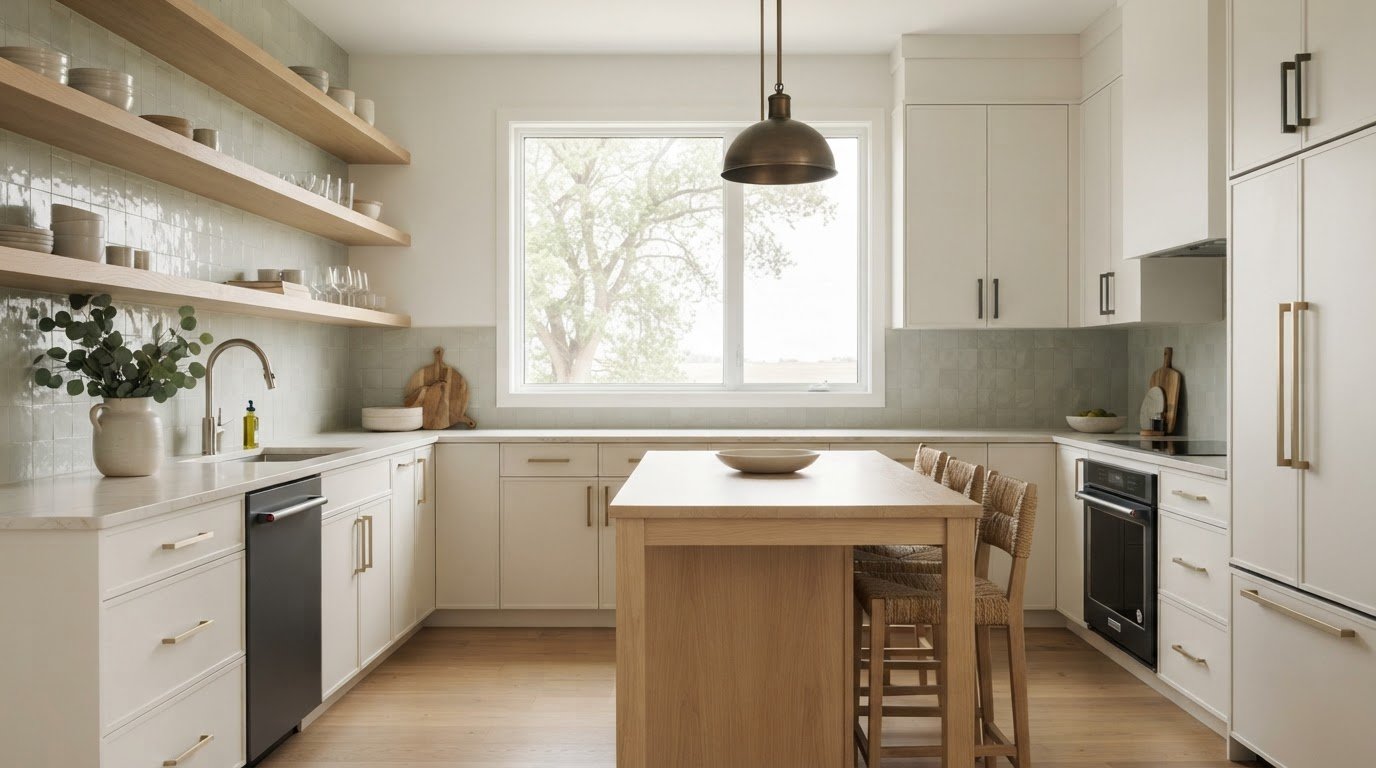
What if your kitchen metals didn’t need to match to feel coordinated? It’s understandable to worry that cabinet hardware, plumbing fixtures, and lighting will compete when their finishes differ, especially if some choices are already in place. Learning how to mix metals in a kitchen starts with a clear hierarchy: select one finish to anchor the palette, then introduce complementary accents with intention.
This guide shows you how to build a considered palette around existing finishes, balance visual contrast, and repeat accent metals so the room feels cohesive rather than busy. You’ll also learn how to assess practical details, such as texture and everyday care, alongside colour and style. With thoughtful professional planning, cabinetry, fixtures, and light placement can work as one connected design plan, supporting a kitchen that feels refined, functional, and personal.
Key Takeaways
- Think of mixed-metal design as a coordinated hierarchy, not a matching set, and choose one finish to anchor the palette.
- Compare brass, chrome, nickel, bronze, and black by their warmth, sheen, and visual weight to find finishes that suit your kitchen.
- Consider how warm-and-cool, light-and-dark, or closely related finishes will shape the room before committing to a combination.
- To learn how to mix metals in a kitchen, inventory existing finishes first, then decide where an accent metal can create intentional contrast.
- Coordinate metal choices with cabinetry, counters, lighting, and daily use so the kitchen feels cohesive as well as functional.
How to Mix Metals in a Kitchen Without Making the Finishes Feel Random
Mixed-metal design combines distinct metal finishes across kitchen elements with a clear visual purpose. Cabinet pulls might have a warm, muted finish, while a faucet or pendant light introduces a cooler or darker note. The goal isn’t to make every piece identical. Instead, each selection should relate to the others through its tone, sheen, placement, or repetition.
When deciding how to mix metals in a kitchen, look beyond a simple list of finishes. A polished surface catches light differently from a brushed or matte one, even when the metals share a similar colour. Surface finishing techniques for metals help explain how surface treatments affect appearance. In a kitchen, those differences can add definition when the finishes also relate to the surrounding materials.
A cohesive metal palette uses repetition to create connection, contrast to add depth, and placement to give each finish a clear role. This is a useful starting point whether you’re planning a full renovation or working with existing fixtures.
Which kitchen details count as metal finishes?
Start with the most visible details: cabinet knobs and pulls, faucet and sink finishes, light fixtures, and appliance fronts. These elements can all influence the palette, but they don’t carry equal visual weight. A small pull reads differently from a broad appliance surface. Stainless steel appliances, for example, may act as a relatively neutral backdrop, though their reflective quality can still affect how nearby finishes appear.
Assess the kitchen as it is, not only as you hope it will be. An existing faucet, sink, light fixture, or appliance can remain part of the plan rather than prompting an automatic replacement. Record its colour and sheen, then compare new selections beside it. Cabinetry, counters, and wall surfaces also provide context, even when they aren’t metal.
Why a deliberate mix can feel more considered
Contrast gives the eye points of distinction. A darker metal against light cabinetry, for instance, can define hardware, while a warmer finish may bring a different quality to the lighting or faucet. Repeating a finish in more than one location helps the choices feel related rather than incidental. The repetition needn’t be exact in scale: a small detail can echo a more prominent fixture.
Surrounding materials shape the result. Warm wood, pale counters, patterned stone, and painted cabinetry can all influence whether a metal appears warmer, cooler, brighter, or more subdued. Light placement matters too, since daylight and kitchen lighting change how reflective surfaces look throughout the day. Compare finish samples with cabinetry and counter materials in the room’s lighting before making a final selection. No pairing works identically in every kitchen. The best mix responds to the space, its existing elements, and the way it’s used.
Choose a Kitchen Metal Palette by Finish, Sheen, and Visual Weight
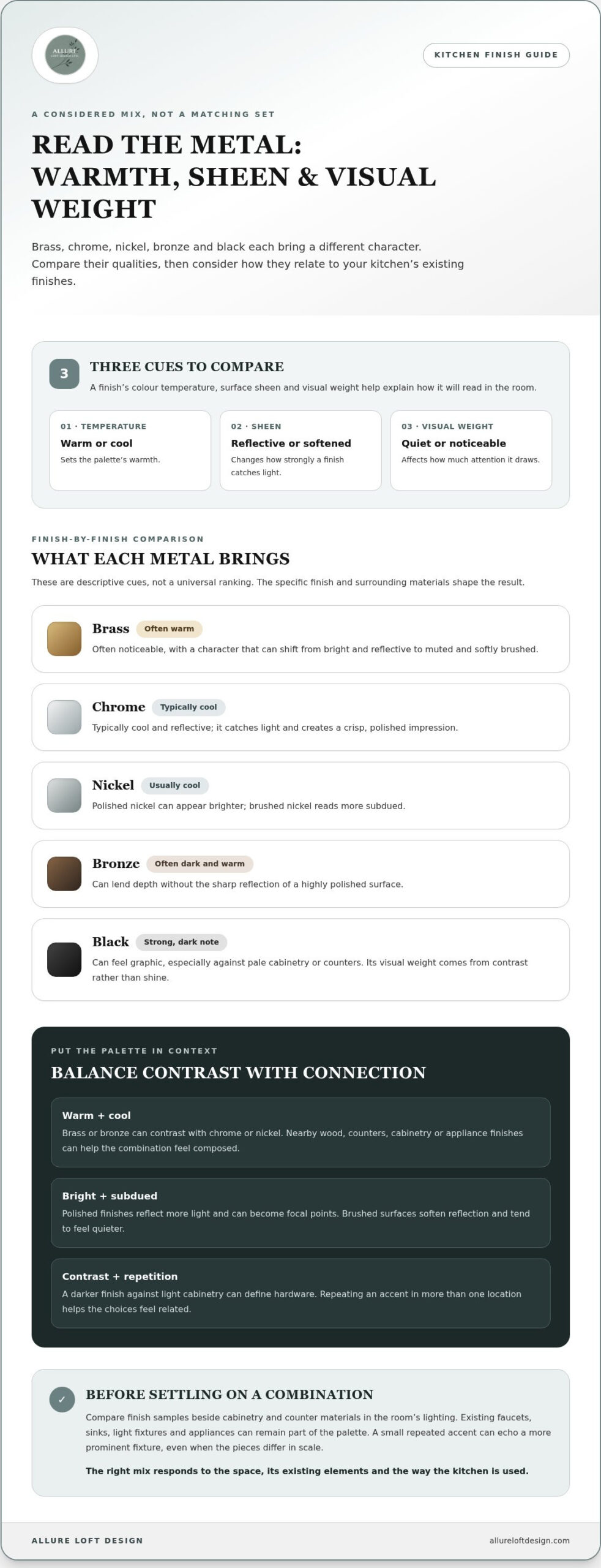
Once you’ve identified the visible finishes in your kitchen, compare each option by three qualities: colour temperature, surface sheen, and visual weight. These cues help explain why metals can feel coordinated without being identical. Brass and bronze often bring warmth; chrome and nickel tend to read cooler; black introduces a defined, dark accent. The effect depends on the specific finish and the materials around it, not on a universal ranking.
- Brass: Often warm and noticeable, with a character that shifts from bright and reflective to muted and softly brushed.
- Chrome: Typically cool and reflective, so it can catch light and create a crisp, polished impression.
- Nickel: Usually cool in tone, with polished versions appearing brighter and brushed versions reading more subdued.
- Bronze: Often dark and warm, lending depth without the sharp reflection of a highly polished surface.
- Black: A strong, dark visual note. Its presence can feel graphic, especially against pale cabinetry or counters.
Finish temperature sets the palette’s warmth, while sheen and visual weight determine how strongly each metal claims attention. This is a useful way to think about how to mix metals in a kitchen: two finishes may work well together in colour but feel unbalanced if both are highly reflective or visually dominant.
How warm and cool finishes can work together
Warm brass or bronze can contrast with cooler chrome or nickel, creating a layered effect rather than a single-temperature scheme. The connection might come from nearby details: warm wood cabinetry can relate to brass, while a cool-toned counter or appliance finish can sit comfortably beside nickel. Repeating a small accent, such as a metal detail in a light fixture, can also help the contrast feel deliberate.
Read the room’s palette as a whole. Warm white, natural wood, and earthy counters may support a warmer metal mix, while cooler stone or painted cabinetry can shift the balance. Neither approach is automatically better. The surrounding colours determine whether the combination feels composed.
How sheen and visual weight shape the mix
Polished finishes reflect more light and can become focal points, particularly on a large faucet or pendant. Brushed surfaces soften that reflection and tend to feel quieter. Dark finishes create visual weight through contrast rather than shine. Consider scale and location together: dark pulls repeated across many cabinet doors may register more strongly than one dark accent on a small fixture.
Finish names alone don’t guarantee a match between manufacturers. Subtle differences in tone, texture, and reflection can be noticeable when pieces sit close together. Compare physical samples beside cabinet fronts and counter materials in the kitchen’s actual light, then view them from across the room and at close range. This helps you assess whether the mix feels balanced in daily use. For guidance that brings finish choices into a broader kitchen plan, explore Saskatoon kitchen design.
Compare Kitchen Metal Combinations Before You Commit
Pairings are easier to assess when you consider the atmosphere they create and the role each finish will play. A warm-and-cool mix can feel layered, a light-and-dark combination can add definition, and closely related tones can create a quieter effect. These are starting points, not fixed formulas. Cabinet colour, counter materials, room light, and the size of each fixture all influence the final balance.
- Warm brass with cool nickel or chrome: This contrast can bring warmth and clarity to the same room. Consider a brass pendant above an island with a nickel faucet, or warm cabinet pulls paired with cooler plumbing fixtures. Nearby wood tones or a counter with warm veining can help connect the finishes.
- Light metal with dark metal: A bright chrome or nickel fixture beside dark bronze or black hardware creates a more defined, graphic look. This approach may suit a kitchen with pale cabinetry, where dark details stand out, or a deeper cabinet colour that gives lighter metal a clear point of contrast.
- Closely related finishes: Similar tones, such as brushed nickel and chrome, can form a restrained palette. Their distinctions may be subtle, so variation in sheen, shape, or placement can keep the composition from feeling flat. This pairing may suit a kitchen where cabinetry and counters already carry strong patterns or colour.
When contrasting finishes create useful definition
Contrast can make an individual element easier to notice. A faucet that differs from the sink area or nearby cabinet hardware can become a considered focal point rather than disappearing into a field of similar finishes. The effect depends on scale and position: a prominent fixture naturally draws more attention than a small pull.
Repetition helps connect the choices. If a darker finish appears on cabinet hardware, echoing it in a light fixture or another visible detail can make the contrast feel deliberate. Assess the whole composition, including cabinetry, counters, fixtures, and appliances, rather than judging each finish on its own. In a Saskatoon kitchen, professional kitchen design planning can bring these selections into relation with the room’s materials and function.
When a quieter, closely related palette feels right
A restrained mix can support a calm kitchen without requiring every surface to match exactly. Similar metal tones may blend gently into the wider scheme, while differences in finish or form provide subtle variation. For example, a brushed faucet can sit near polished hardware if their tones feel compatible and their placement gives each a distinct role.
This isn’t the only route to a refined result. A kitchen with simple cabinetry and quiet counters may welcome stronger contrast, while a room with expressive stone or wood may call for softer metal distinctions. As you compare options, ask what deserves attention and what should recede. That question helps you decide how to mix metals in a kitchen in a way that suits the space, rather than following a universal rule.
Follow These Steps to Mix Metals Across Kitchen Fixtures and Hardware
A thoughtful selection process makes finish decisions easier to assess before you commit. Begin with what’s already in the room, then add new choices in relation to the kitchen’s materials, focal points, and daily use. This step-by-step approach to how to mix metals in a kitchen can help you turn a collection of individual samples into a coordinated plan.
- Inventory the existing and planned finishes. Note the faucet, sink, cabinet hardware, visible appliance finishes, and lighting already in place or under consideration. Record each finish’s colour and sheen, and mark which elements will remain. Include cabinetry, counters, and natural and warm materials such as wood, since they shape how nearby metals appear.
- Identify focal points and fixed elements. Look across the kitchen from its main entrances and work areas. Notice where your eye naturally lands, perhaps on an island, a distinctive light fixture, or a prominent faucet. No single element has to dominate. The purpose is to understand which finishes are already visually prominent and where a new finish could add definition without distracting from the overall composition.
- Select an anchor finish. Choose the metal that will establish the palette’s character. It may already be present in a fixture you plan to keep, or it may be a new choice for hardware or lighting. Consider its relationship to the cabinetry, counters, and appliance surfaces, then decide which other elements can support it rather than compete for attention.
- Choose a contrasting finish and give it a clear role. Decide where contrast will be most useful. For example, a cooler faucet finish could stand apart from warmer cabinet pulls, while a darker light fixture could add definition above a lighter island. Treat the location and scale of the finish as part of the decision, not an afterthought.
- Review samples in context, then refine. Place samples beside cabinet fronts, counter materials, and nearby wood or other natural materials. Check them under the kitchen’s existing light placement at different times of day, since changes in light can shift how a finish reads. If possible, view the combination from the doorway, at the island, and close to the sink. Adjust a selection if one finish draws attention away from the balance you intended.
Repetition can help link contrasting choices. If an accent finish appears only once, consider whether a second, smaller detail would make it feel more connected. Repetition needn’t be exact or evenly distributed; its purpose is to create a visual relationship between different parts of the room. Step back after each adjustment and assess the whole kitchen, rather than judging each sample in isolation.
Kitchen cabinetry, lighting, and fixture selections work best when planned as connected decisions. Plan your Saskatoon kitchen design with professional guidance that brings materials, function, and finish choices into harmony.
Bring a Considered Metal Palette Into Your Saskatoon Kitchen Design
A metal palette works best as part of a kitchen plan shaped around the room and the people who use it. Cabinet colour and style, counter materials, lighting, and daily routines all inform how finishes feel. Space planning also helps clarify where fixtures and task areas belong, so visual choices support movement and comfort as well as appearance.
Connect metal choices to the whole kitchen
Consider finishes alongside cabinet details, counter surfaces, and the lighting plan. A metal beside patterned stone may read differently than it does against a quiet surface, while hardware repeated across cabinetry can shape the room’s overall character. If you’re choosing materials for a renovation, consider durability and eco-conscious options alongside colour, texture, and the kitchen’s intended use. For broader inspiration, explore contemporary home design in Canada; homeowners planning a new build can also consider early interior design for new construction.
Thoughtful choices can support a kitchen that feels harmonious and practical, rather than treating each finish as a separate decision. The result should suit your home’s character and the routines that happen there.
When professional planning can help
Professional planning brings cabinetry, lighting, and fixture selections into a connected design plan. A designer can consider how these choices relate to materials, function, and the room’s lighting needs as the project develops. For process context, the interior design process offers a useful overview of how design decisions can be organized.
If you’re planning a kitchen in Saskatoon, explore Allure LOFT Design’s residential interior design services for considered support in shaping your home’s interiors.
Shape a Kitchen That Feels Like Yours
Your kitchen can express your priorities through the choices you live with every day. As you consider how to mix metals in a kitchen, think about the atmosphere you want to create and how the space can support your routines. A few considered decisions can give the room a character that feels personal rather than prescribed.
As a next step, note what you value most in your kitchen, from ease of use to a calmer visual feel, and keep those priorities close as you refine your design. Let them guide your choices so your kitchen takes shape with clarity and feels distinctly your own.
Frequently Asked Questions
Can you mix brass and chrome in a kitchen?
Yes, but consider how close the two finishes will sit and whether both will be prominent at once. If brass pulls and a chrome faucet are within the same sightline, compare their colour undertones in the kitchen rather than relying on finish names. You can also use one on smaller details and reserve the other for a more noticeable fixture, so their relationship feels considered rather than accidental.
How many different metal finishes should a kitchen have?
Choose finishes according to the kitchen’s visible elements and how much visual variety you want, rather than following a set count. A useful test is to name the purpose of each finish: does it relate to an existing feature, distinguish a fixture, or add a detail you value? If a selection has no clear role, it may be unnecessary. Consider the full room, including appliances and adjoining spaces, before adding another finish.
Should kitchen cabinet hardware match the faucet?
No. Rather than matching finishes, consider whether the hardware and faucet feel compatible in scale and character. For instance, substantial cabinet pulls may sit comfortably with a sculptural faucet, while delicate knobs can feel more suited to a restrained fixture. Also consider how often each element is handled and whether its shape is comfortable to use. The practical experience of opening drawers and using the sink matters as much as appearance.
What metal finish goes with stainless steel appliances?
Several finishes can work with stainless steel appliances. The best choice depends on the appliance’s appearance and the kitchen’s other materials. Look at the appliance fronts and handles together, especially if they’re close to cabinet hardware. If the appliance finish is visually prominent, keep nearby details quieter; if it’s integrated or less noticeable, other fixtures can have a stronger presence. Assess the room from its main entrances as well as at the work surfaces.
Can you mix brushed and polished metal finishes?
Yes. Before selecting both, consider where fingerprints, water marks, and frequent handling are most likely to affect how surfaces look between cleanings. A high-touch faucet and cabinet pulls have different everyday demands from a pendant fixture positioned overhead. Check the care guidance for the specific finishes you’re considering, then balance those practical needs with appearance. This can help you choose details that remain comfortable to maintain as well as pleasing to see.
How do I choose metal finishes for a kitchen renovation?
For a renovation, begin by deciding which elements are staying, which are being replaced, and what matters most in the finished kitchen. Then review how your choices relate to the renovation’s broader priorities, such as storage, preparation tasks, cleaning routines, and the character of adjoining rooms. To plan how to mix metals in a kitchen, consider finishes alongside cabinet and lighting selections before finalizing individual details. This keeps small decisions connected to the overall renovation vision.
Do mixed-metal finishes work in a small kitchen?
Yes. In a small kitchen, consider how a finish reads at close range and whether it draws attention to an area you want to emphasize. For example, a distinctive detail at a breakfast nook or compact island can give that area a sense of identity without adding decoration across every surface. Keep sightlines in mind, especially where the kitchen opens to a dining or living area, so the finishes feel appropriate from both spaces.